| | | | | | | | | | | | | | | | | | | | | | | | | | | | | | | | | | | | Kia ora tātoua
This newsletter is going out to members one week before the election on November 7th. If you are anything like me you are suffering from “Election Fatigue” and would just like to see the decision being made at this point. Certainly, the outcome is completely unpredictable and the role of Opportunity in any final coalition, if they achieve over 5% of the vote, adds a new dimension we haven’t seen before. What is the most disappointing aspect of the whole election campaign to me is the lack of a compelling vision for the future from the two bigger parties, and how minor parties are trying to appeal to their voting bases at extreme ends of either side of the political spectrum. This is leading to the societal division that we are seeing more strongly at the moment, polarising views to the hard left and right. A mature MMP system would see the two centrist parties (Labour and National), whose policies are the most closely aligned, forming a grand coalition and working together for a strong economic country and a more collaborative society. The fact that such a centrist alignment will not occur is a combination of the legacy of our historical First Past the Post system of two major parties having to campaign on differences rather than similarities, along with egos and personal ambitions getting in the way of the greater good. The downstream impact is that a coalition government is held to ransom by smaller parties and their more extremist policies in order to attain a parliamentary majority! We were very pleased by the attendance at our pre-election political panel that was held recently and facilitated by Michael Morrah from NZME. The concerning realistion was that none of the parties had a specific rural health manifesto, or could even point to one specific rural health policy they were pushing. When each of the representatives were asked if they supported the concept of ‘Rural-Proofing’ policy and implementation, they all agreed that rural voices should be involved in the development of new health policy to ensure that rural communities and whānau would benefit. We note that the current Minister of Rural Health, Matt Doocey, admitted that he didn’t like the term rural-proofing, but if it meant listening to rural voices, then he was very supportive of that. The telling point is that we are not aware of any rural voices being consulted over the development of any of the Parties’ health manifestos. If that had been done we would have been sure to point out to Labour the folly of providing untargeted free GP visits into rural practices that are already chronically understaffed; and to National that the greatest health need (poorest health outcomes) is in remoter rural communities, especially among rural Māori. Where are the policy incentives to get more clinicians working and staying in those communities, where are the policies to remove barriers to financially stressed whānau able to access technology to utilise telehealth opportunities, and the affirmative actions to get preferential diagnostic screening and treatments to those Māori dying many years earlier in rural areas than non-Māori in urban settings? But we must all exercise our democratic right to vote over the next week so that our collective voices are heard. I am sure you will all carefully consider which Party you believe will provide the best future for our country, and which of your electorate MP candidates is most approachable to listen and respond to local rural health issues; then use your two votes to best effect. I hope you are also aware of some pretty important work that we are doing on behalf of the sector that will impact rural health in the medium term. These include: - Helping rural practices in the roll-out of the Rural Urgent and Unplanned Care contracts, to ensure that feedback on the Service Specifications and funding models deliver a fit-for-purpose agreement. Note that HNZ will hold a sector webinar in the near future to talk through their plans on the roll-out and answer questions. We will promote this when a date and time are decided.
- Working with a group of HNZ staff, sector representatives and data specialists, to develop a recommendation to PSAAP negotiations in the New Year on how the Rural Funding Pool should be allocated.
- Collating survey results from rural practices on the state of their workforce and business environments. We hope to release the findings next week.
- Supporting our members in the Tararua region, where healthcare is currently experiencing significant challenges.
- Responding to the recent news that Otago University’s very successful Interprofessional Education programmes on the West Coast and Tairawhiti regions are being discontinued.
We are happy to receive any of your questions on these pieces of work if you reach out. On a positive note, I would like to give a Shout-Out to the rural health researchers who continue their vital studies into rural health outcomes and identify important issues – both positive and negative. We need this scientifically derived and defendable data to advocate with Politicians and Health NZ for a better deal for rural whānau and their healthcare providers. For those who like to read this stuff, I encourage you to sign up to Otago University’s ‘Leaning on Fenceposts’ website https://rhrn.nz/lofp where all recently published rural health articles are promoted. In the last few months, published research findings have included work on: - Why rural allied health professionals choose to stay working in rural areas
- What is needed to strengthen rural medicine as a specialty in New Zealand
- The difference in access to CT scans between rural and urban populations in NZ
- The impact of rural surgical outreach clinics in improving access to surgical care for those in rural communities
- And more…
Next week I am heading up to Northland for a couple of days and will visit a number of the rural practices along with representatives of our NZMedjobs/NZLocums recruitment team. We are keen to hear first hand from our members about how things are playing out on the ground in Northland. We were surprised to learn yesterday that Minster Doocey was announcing the launch of the fourth Rural Training Hub in Northland. We will be interested in who has been involved in the design of this latest training hub and how it will operate. In the meantime, I hope I have encouraged you to wander down to the polling station to vote.
Ngā mihi nui Grant | | | | | | | | | | | | | | | | | | | | | | | | Rural Health Pre-Election Panel - Watch the Recording | |
Hauora Taiwhenua brought political parties together for our Rural Health Pre-Election Political Panel on Monday 12 October, providing an opportunity to discuss the issues and priorities shaping the future of rural health in Aotearoa.
Moderated by journalist Michael Morrah, the online panel featured representatives from National, Labour, New Zealand First, the Green Party, ACT and Opportunity. The discussion explored rural health priorities ahead of the General Election on 7 November.
For more information about Hauora Taiwhenua’s rural health priorities, read our Rural Health Election Manifesto. | | | | | | | | Help shape the future of General Practice Rural Funding | |
Help shape the future of General Practice Rural Funding Health NZ is reviewing the drivers of rural primary care costs to help inform the future design of rural funding, and rural practices are being asked to contribute. An independent practice cost survey is being undertaken by Synergia, looking at the realities of delivering care in rural communities, including workforce, infrastructure, travel, urgent care pressures and other factors that affect costs. We encourage practices to take part in the survey. Your input will help ensure the review reflects the practical realities and costs of providing rural general practice services.
Survey details: - One response per practice, from a practice owner or manager
- Approximately 20 minutes to complete
- Closes Tuesday 3 November
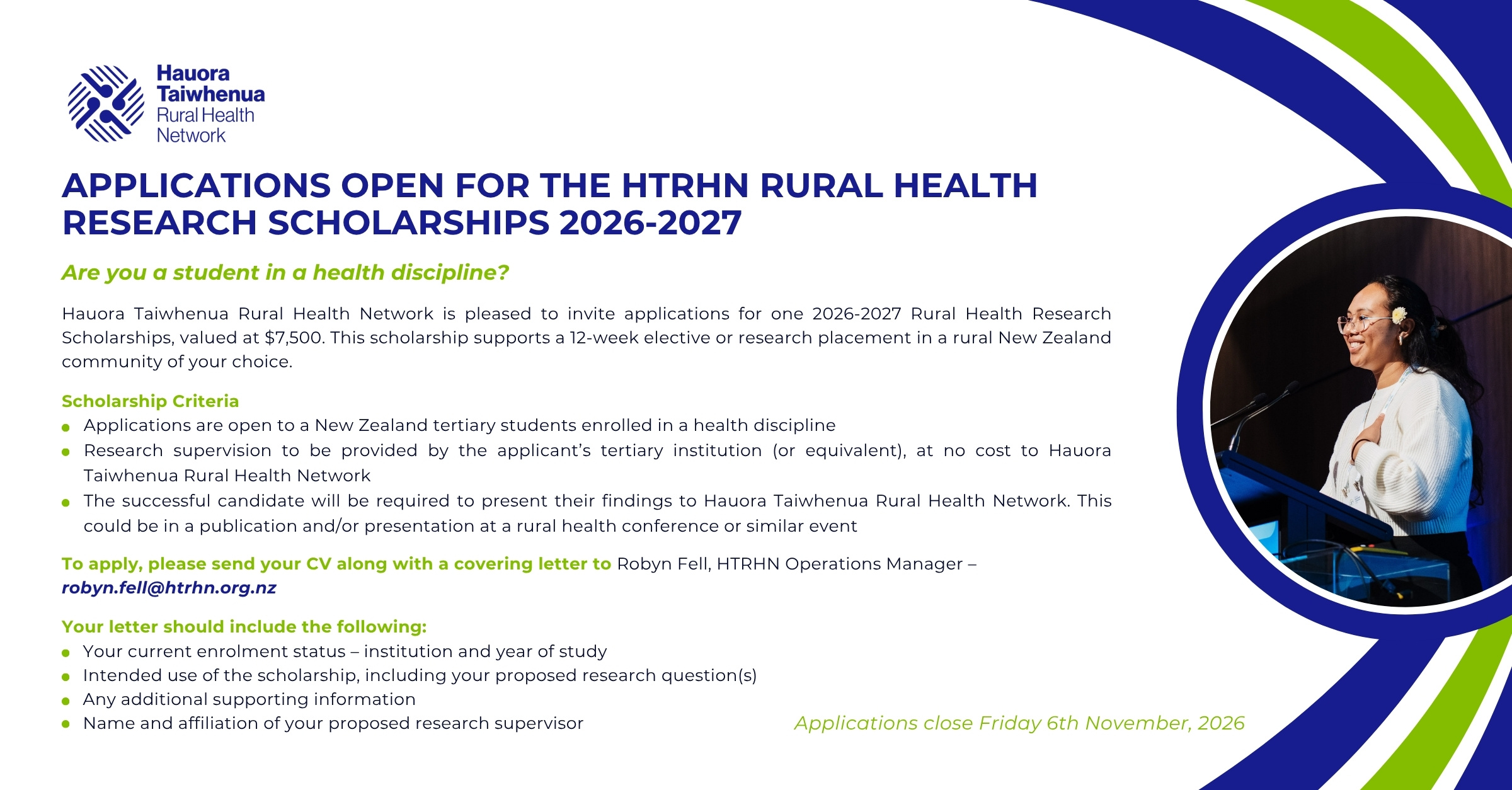
| | | | | | | | | | Hauora Taiwhenua Rural Health Student Research Scholarship - CLOSING SOON | | | |
To apply, please send your CV along with a covering letter to Robyn Fell, HTRHN Operations Manager – robyn.fell@htrhn.org.nz | | | | Hauora Taiwhenua Rural Secondary School Leavers Health Career Scholarships 2026 - OPEN NOW | | | |
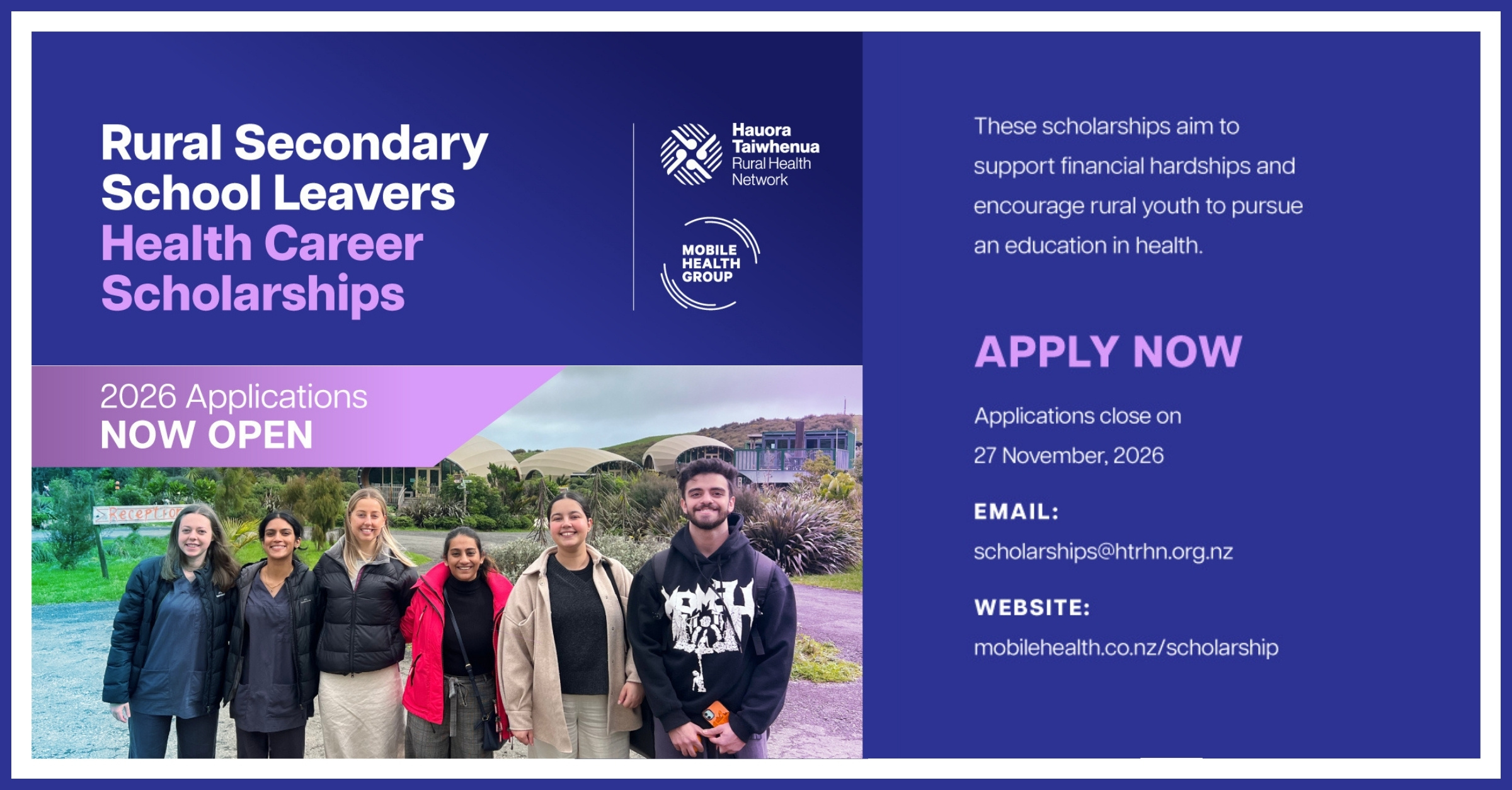
Hauora Taiwhenua Rural Health Network is pleased to open applications for the 2026 Rural New Zealand Health Scholarships, in association with Mobile Health Group, Waitaha Primary Health and the Townshend-Thomas Charitable Community Trust, providing financial support for rural students embarking on health studies in 2027.
This year, we are offering five scholarships valued at $5,000 each to support rural youth entering their first year of full-time undergraduate study in nursing, medicine, or allied health in 2027 across New Zealand universities, polytechnics, or private training establishments (PTEs). In addition, we are delighted to feature a dedicated scholarship specifically for a student graduating from Hauraki Plains College, proudly funded by the Townshend-Thomas Charitable Community Trust.
The closing date for applications is 27 November 2026. For more information on how to apply and the eligibility criteria, see the scholarship information and guidelines here. | | | | | | | |
Nineteen years from the soapbox
Kia ora tātou,
Each year at the Rural Hospital Summit, the soapbox session gives every organisation a turn to tell the room what's keeping them awake at night. Mobile Health isn't a rural hospital, but our surgical bus parks beside most of them, so I'm lucky enough to get a turn. This year, waiting for mine, I realised it was 19 years to the day since I started at Mobile Health. So it got me thinking: That's long enough to wear out a few sets of tyres, learn most of our rural roads by their potholes, and see how far we've come.
Then Back then there was no rural health plan. The Ministry of Health had no one dedicated to rural, and the official line was that there were no rural inequities because everyone was treated the same. That's a bit like saying a southerly and a nor'wester are the same because they're both wind. Anyone who'd waited for a GP appointment knew better. The road also taught me that when you've seen one rural town, you've seen one rural town. Each is its own ecosystem, held together (or not) by relationships, people and culture. So care varied enormously from town to town. In 2007 our surgical unit rolled into Dannevirke for the first time. Sharon Wards was running the hospital, and the fire brigade sprayed an arch of water over the bus as we arrived. You could almost hear the marching band. The culture across the hospital and primary care was something special. Sharon later led Tararua Health Group and is now Tararua's Deputy Mayor. Tania Chamberlain, who followed her, carried that warmth forward and has since started a new service in town. Since these people have moved on, the relationships have changed. Dannevirke has had a tough year, a reminder that good culture takes years to build, can unravel quickly, and should never be taken for granted. I suspect there will be green shoots in the area again as relationships are repaired.
Now Today there are rural-focused teams in the Ministry of Health, and Health New Zealand has a dedicated rural team with a plan. Not everyone agrees with the plan (this is rural New Zealand, and we don't all agree on the weather), but there is a plan, and equity and funding are firmly on the table. It's not often you can put "bureaucrat" and "great" in the same sentence, but we have some genuine ones batting for us. PRIME tells the story. Not long ago, practices were pulling out. Clinicians were called out at 2am, paid as little as $160 for several hours' work, then expected at clinic next morning. The payments have improved. You're no less tired at 7am, but at least your bank balance has had a decent night's sleep. Big changes are coming. PRIME will be woven into the Rural Unplanned and Urgent Care programme so care is consistent everywhere. You shouldn't need to choose which road to have your accident on to know you'll be well looked after.
One song sheet The NZ Rural General Practice Network pioneered rural advocacy for decades. Later, I joined Jo Scott-Jones, Sharon Wards, Bill Esenbach and others in founding the Rural Health Alliance Aotearoa New Zealand (RHAANZ) as a wider rural voice. Both organisations going in the same direction. After a review around 2020, the Network, RHAANZ and the chapters came together as Hauora Taiwhenua. It's the biggest advance in rural health advocacy I've seen: everyone singing from the same song sheet, with our Te Tiriti partner, Te Rōpū Ārahi, alongside. Grant often describes advocacy as dripping water on a stone. Looking back over 19 years, I can tell you the stone has moved, and so have a few mountains.
Next I've been on the board since Hauora Taiwhenua began, two terms of two years, and I intended to step aside for fresh blood. I'd even told the Rural Communities chapter as much. But we need a skills-based board: people with vision and a wide view across the whole countryside. Our constitution lets anyone throw their hat in the ring, which is healthy, but it doesn't guarantee the right mix of skills. A good A&P judge doesn't pick the champion by asking the crowd which one they like best. So I'm considering standing once more, as a backstop. If you have vision and skills to offer, please put your hand up too. Rural New Zealand earns a big share of our export dollars, hosts our visitors and feeds the country, yet its health care hasn't always reflected that. Weaving equity through everything we do is the mahi ahead, and I'm genuinely excited about it. Nineteen years ago, a town turned out the fire brigade to welcome a surgical bus. Strategies, plans and funding formulas all matter, but the real test is simpler: does every rural town have a health service worth turning out the hoses for? That's the future worth working for.
Ngā mihi, Mark Eager Board Member, Hauora Taiwhenua | Chief Executive, Mobile Health Group
| | | | | | | | | |
Early bird registrations are now open for the National Rural Health Conference 2027!
Taking place in Ōtautahi Christchurch from 29 April-1 May 2027, NRHC27 will bring together rural health professionals, researchers, community representatives and health sector partners to share knowledge, celebrate innovation and explore solutions to improve health outcomes for rural communities across Aotearoa New Zealand.
Under the conference theme Rural Health Equity through Empowering Primary Care Teams, the programme will explore how we can strengthen rural primary care teams, support and sustain the rural health workforce, and empower communities to lead solutions that address rural health inequities.
Key information: Early bird registrations open: NOW OPEN Early bird registrations close: Monday 15 March 2027 Conference dates: 29 April–1 May 2027 Location: Te Pae, Ōtautahi Christchurch
For registration details and further conference information, visit our conference website below.
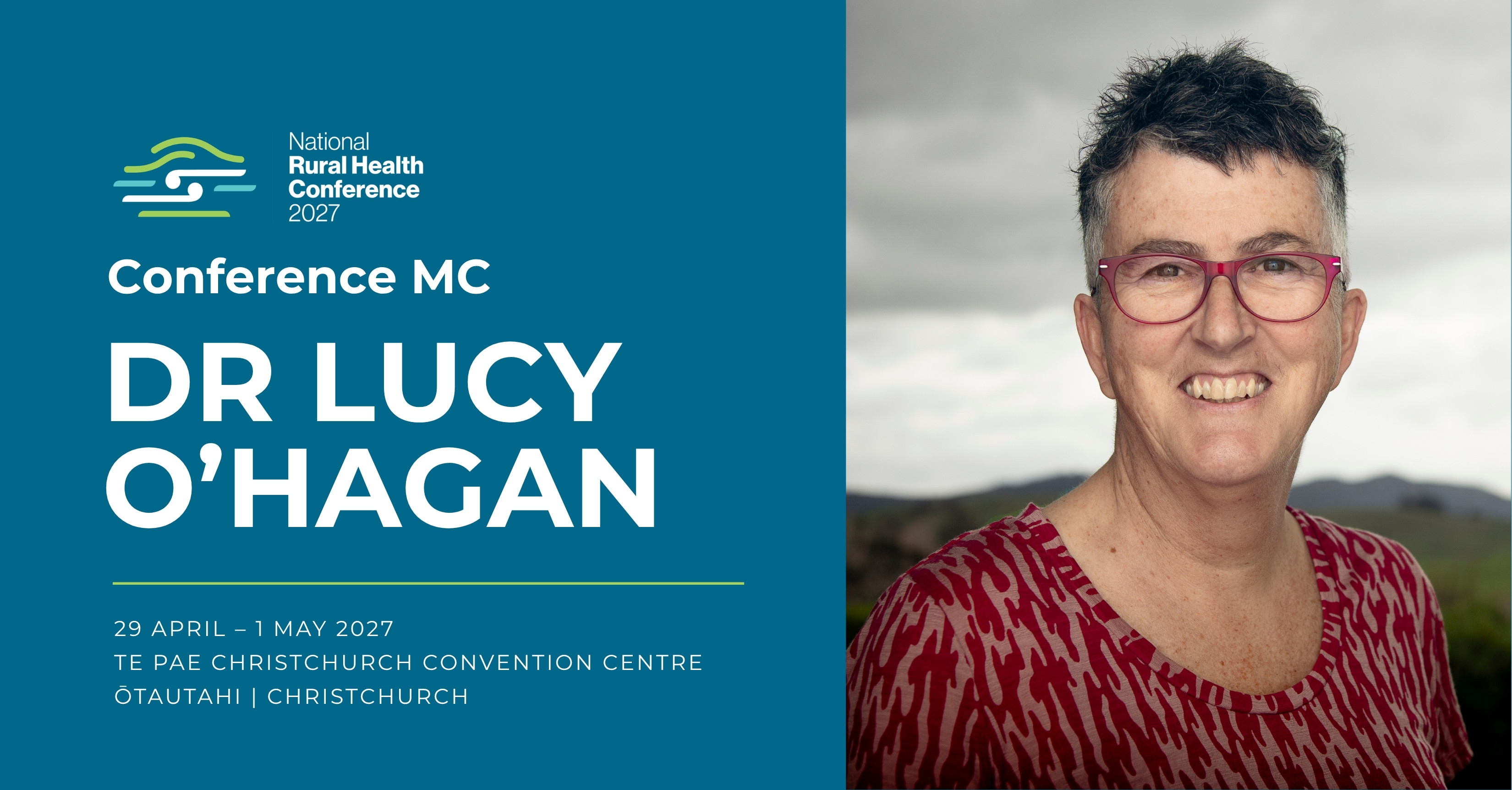
We look forward to welcoming you to Ōtautahi Christchurch for NRHC27. Please share this opportunity with your colleagues and networks. | | | | | | Introducing our Conference MC: Dr Lucy O'Hagan | | | |
Lucy had been a rata hauora/GP for over 30 years including 20 years as a rural GP in Wānaka. She has also worked for kaupapa Māori services, most recently for Oratoa Cannons Creek in Porirua.
She has studied the social science of medicine, narrative practice and kaitiakitanga and taught GP trainees for over 25 years.
She is a columnist for NZ Doctor magazine and her 2025 book 'Everything But the Medicine' was longlisted for Ockham NZ Book Awards.
'Inside the GP Consultation' her one woman show with 32 characters is currently touring New Zealand. | | | | | | | | | | Rethinking rural healthcare: the Kawhia approach A chat with Dr John Burton | |
When Dr John Burton took over Kawhia Health Centre in 1992, he faced a challenge familiar to many rural practices: how to provide a broad range of healthcare services with a small team and limited resources. Drawing on an approach he had encountered while working in West Africa, he began exploring how staff could develop new skills and take on additional responsibilities to better meet the needs of their community.
The approach was shaped by Kawhia’s circumstances. Recruiting staff to a remote community was difficult, and the practice could not employ a specialist for every area of care. Rather than relying solely on recruiting more people, the team looked at how it could build capability within the workforce it already had.
Adapting an approach to local needsBefore moving to Kawhia with his wife, Sue, John had worked as a general practitioner in a mission hospital in Benin. There, he observed a programme in which healthcare workers received training in specific areas of basic healthcare, including triage and the assessment and management of conditions such as malaria and diabetes. Patients whose needs fell outside those workers’ training were referred for further care.
John adapted the principles he had observed to the New Zealand rural context. With support from government funding for rural healthcare, Kawhia Health Centre was able to expand its team’s skills and the services it could provide.
The focus was on matching training and responsibilities to the needs of the community, while ensuring staff knew when to seek support or refer patients to someone with the appropriate expertise.
Building skills within the teamRegistered nurse Kirsty Newton is one example of how this approach developed. After joining the practice, she took on a part-time role supporting people with diabetes. As her role expanded, she completed further training and developed skills across a wider range of care.
Her work included supporting people with asthma and other respiratory conditions, providing diabetes education, helping manage heart failure, and following up with patients after hospital discharge. She also undertook home visits, including follow-up for new parents, and supported people experiencing dementia and mental health challenges.
Additional training helped Kirsty respond to different needs in the community. She completed courses in dementia care, hospice care and incontinence assessment, among others.
Home visits were an important part of her work. During the COVID-19 pandemic, telephone consultations helped maintain contact with patients, but in-person visits also gave her an opportunity to better understand people’s living circumstances and identify factors such as social isolation that could affect their wellbeing.
Her work also relied on collaboration with other health professionals, including district and public health nurses, hospice services and the local primary health organisation. These connections helped the practice draw on wider expertise while maintaining care close to home.
Recognising skills beyond traditional rolesTuiAnne Bishop-Hay’s experience illustrates another aspect of the approach: recognising the contribution people can make when they receive appropriate training and support.
Born in Kawhia, TuiAnne joined the health centre as a receptionist after the local post office where she worked closed in 1988. Through her work at the practice, she became increasingly involved in supporting people with diabetes, a significant health concern in the community.
In 1994, she applied for and was accepted into a five-week diabetes course that had been intended for registered nurses. Her participation helped open the way for other non-registered healthcare workers to access the training.
TuiAnne went on to help run diabetes clinics, arrange appointments with visiting registered nurses and follow up with patients about their medication and diet. After returning to Kawhia in 2015 following a period working elsewhere, she continued supporting diabetes care through patient monitoring and follow-up.
This included phoning or visiting patients to check their blood glucose levels and following care instructions provided by the visiting nurse. TuiAnne worked within the knowledge and training she had gained, referring patients to the appropriate health professional whenever their needs went beyond her role.
Her familiarity with the community also helped her connect with patients and understand their circumstances. Home visits were particularly valuable because they offered insight into the wider family and living situations that could affect someone’s health. The practice also arranged regular visits from a podiatrist, helping people with diabetes access another important service locally.
TuiAnne’s experience shows how a person’s existing knowledge of a community can complement additional training and help make ongoing care more accessible, while maintaining clear boundaries around clinical responsibilities.
Care shaped by community connectionsAcross these examples, the common thread is a team adapting its skills and ways of working to local needs. Training enabled staff to contribute in new ways, while collaboration with visiting and community-based health professionals helped extend the support available through a small practice.
Local relationships also mattered. Knowing patients and their whānau, understanding the realities of living in a remote community, and being able to follow up in person all helped the team tailor its approach to individual circumstances.
John’s work providing after-hours care has also been part of the practice’s commitment to its community. The service has access to Ka Ora Telecare when additional support is needed, providing another option for people seeking care outside normal hours.
Lessons for rural healthcareKawhia’s experience highlights the potential of developing the skills already within a rural health team. It also demonstrates the importance of appropriate training, clear responsibilities and connections with other health professionals.
There is no single approach that will work for every community. But where recruitment is challenging and resources are limited, making the most of a team’s existing capabilities can help rural practices respond to local needs and bring a wider range of care closer to home. | | | | Rural Communities Report October 2026 - Colin Hannah | |
Across the North Island it is starting to dry out. In fact, it has been faster than what had been expected. The water table has dropped below the level of the small race drains on the farm. It is expected that fences can be repaired with out post holes filling with water for the first time for about two years.
An update since the last report is that I had a few anxious moments on the 23rd of September. I am back walking around unaided and have been working full time since the 12th of October. Thank you to you all for your concerns.
I had some help from my brother and my nephew to cover the farm whilst I was out of action for almost a week. It seems my animals weren’t that happy with the helpers; they really only see me on a daily basis and don’t like people that they don’t know. Some of the younger stock made things difficult for my willing helpers. They were well looked after. They are now back to following me around with voice calls and calling out to me to hurray up, they want a new pick.
It was an interesting experience at Whangarei Hospital, and staff do work hard. The first day I did need some help and supervision, but after that some of the conditions were unnecessary. Most of the nursing staff just let me get on with what had to be done and the rules were ignored as they had so much work to do.
The team at On Farm Support and Rural Support Trust have been promulgating the idea that New Zealand could see some issues arising with the El Nino strengthening across the Pacific. Drought is a real possibility. The workshops and reminders have been useful. We are also suggesting that drought could be interspersed with floods and rural people need to be aware of the conditions. There is build up of moisture in the tropics at levels we haven’t seen before. It is possible for the build-up to overflow into the more temperate regions. This has been seen in other parts of the world already. Just watch for lows forming off Byron Bay, the convergence of the Coral Sea and the Tasman Sea.
Federated armers have suggested to farmers that they shut up paddocks on the slightest improvement in grass growth to ensure that they have conserved feed on hand if indeed a drought or other feed restrictions appear.
In Northland rural people are used to adverse events and just seem to get on with it. It has been a great pleasure to work with so many of the Northland people following these events. Farmers are practical people; they are aware of the issues following events. Lack of money, time, manpower, people, supplies. I am aware of people still fixing repairs after Gabrielle.
The latest on Bird Flu in New Zealand is that we have only seen 3 cases of the highly pathogenetic (H5N1) influenza in New Zealand. The latest bird found was on the 23rd of August 2026. There have been zero detections in our commercial poultry to-date. Just a reminder to those concerned, the latest information is on the MPI web site.
The farmers in the south have had a serious weather event to contend with. Sheep farmers have had a worrying time with loss of new born’s due to the weather conditions.
The research indicated that the beef price will remain high for this season and into the next as the American farmers rebuild their herds. There has been a serious drop in beef cow numbers in the US to the lowest number since 1951. This has been caused by lingering drought, Urban Sprawl, increased on farm costs.
Increased on farm costs is something that New Zealand farmers are experiencing. Farmers are reporting to me that pricing is good, but farm margins are shrinking. The latest Federated Farmers profitability questionnaire would indicate, that approximately 20% of farmers could be experiencing loss. In Northland farmers have tightened their belts, and hearsay indicates it is happening elsewhere. A number of farmers that I know have reduced debt for their farming operations by using some of the Fonterra sale return to reduce exposure to their banks.
On farm productivity is possibly ahead of the rest of New Zealand. Farmers have invested in Halter type products which have improved their use of time. Halter allows for better use of feed and isn’t aligned to fences or their condition. It has cattle moving around the farm by phone direction. Cows can be on their way to the milking shed while the farmer is having his afternoon tea. It also assists with health monitoring, and this can be picked before any signs are physically detected. Automation of equipment, precision placement of fertiliser, measurement of harvest by square metre etc have had a huge influence on productivity. In many instances it has kept farming viable.
The next time I communicate the election will be over and hopefully we can get on with getting the country back to normal. Our local Regional Council have just regularised a practise that has cost the community a fortune, by approving a thirty hour working week but all staff retaining their 40-hour salary. It could be depressing. | | | | Waikato Rural School Visit Highlights | | | | | | | | | | Member Spotlight: Mayor Marie Black on rural health and community | |
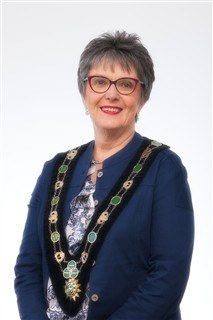
From supporting rural families through Plunket to leading Hurunui District Council, Mayor Marie Black brings a lifelong commitment to healthy rural communities. With the Council now an organisational member of Hauora Taiwhenua Rural Health Network, she shares why collaboration and practical, locally informed solutions matter. For Mayor Marie Black, rural health has been a constant throughout her life and career. Born in Waikari and raised in the Hurunui district, she spent 25 years supporting rural families through Plunket before moving into local government. Now serving her third term as Mayor, Marie continues to draw on that experience to advocate for her community and strengthen connections between health providers, local government and community organisations. Marie and her husband have farmed a generational dryland sheep farm in Hurunui, where both their families have lived and farmed for more than 130 years. They have raised four children and are now grandparents to nine.
| | | |
Her commitment to community health began long before she became Mayor. In 1992, Marie joined the New Zealand Plunket Society as a community karitāne, working across rural Hurunui and Waimakariri. She supported predominantly first-time parents through the transition to parenthood, often travelling long distances to visit families in their homes.
For Marie, the most meaningful part of the role was being welcomed into people's homes, listening to their experiences and helping them navigate a significant period of change. “I have a strong bias towards health and connecting and building relationships within the community,” she says. That experience continues to inform her approach to local government. After being elected as a Hurunui District councillor in 2010, Marie became Mayor in 2019, the first woman to hold the role in the district. Supporting healthcare closer to home Hurunui covers approximately 8,640 square kilometres and has a population of around 14,500 people spread across 13 small communities. While the district is known for its farming, tourism and wine industries, its size also presents challenges for accessing healthcare. The district has five medical and health centres, with some residents travelling considerable distances for routine appointments. Accessing secondary healthcare in Christchurch can mean a journey of up to two hours for some people. Marie says maintaining and strengthening healthcare close to home is important, particularly for older residents who want to remain healthy and independent in their own communities. One example of how local connections can make a difference is Together Hurunui, a non statutory collaborative group chaired by Marie that brings together representatives from health, education, police, rural support and community organisations. Through regular stakeholder hui held around the district's five health centres, providers can discuss local issues and identify gaps in support. Earlier this year, conversations with practice managers highlighted the need for a dedicated social worker to support older people. Working alongside the Council's Welcoming Communities facilitator, Marie helped explore potential funding through the Department of Internal Affairs. The result was a one-year pilot bringing the five health centres together to provide dedicated social work support for older people across Hurunui. The pilot will help assess how this support can contribute to older residents remaining healthy in their own homes and whether the approach could be sustained longer term. For Marie, the initiative demonstrates the value of bringing people together, understanding local needs and finding opportunities to turn those conversations into practical action. “As a mayor, it's actually about putting your neck out, so to speak, and seeing if you can facilitate that and get a result for your community,” she says. The community connections that make a difference Healthcare access is not just about the availability of a medical practice. For people living in rural areas, getting to an appointment can be a challenge in itself. Marie is also a trustee of a community vehicle trust serving her local area. Connected to the local health centre, the trust provides transport for residents who need to attend medical appointments or access other essential services but cannot rely on family transport or public transport. The service operates through community-owned vehicles and volunteer drivers, with a modest charge for return journeys. Marie says the trust has purchased a second vehicle in response to demand, with some vehicles making two trips to Christchurch in a day. For residents who live alone or have limited transport options, these services can help them remain connected to their community and access appointments further afield. Hurunui District Council also owns 35 social housing units across the district, providing another form of support for community members, including older people who want to age with dignity. These initiatives reflect a broader understanding of rural wellbeing: health is influenced not only by clinical services, but also by transport, housing, social support and the connections that help.
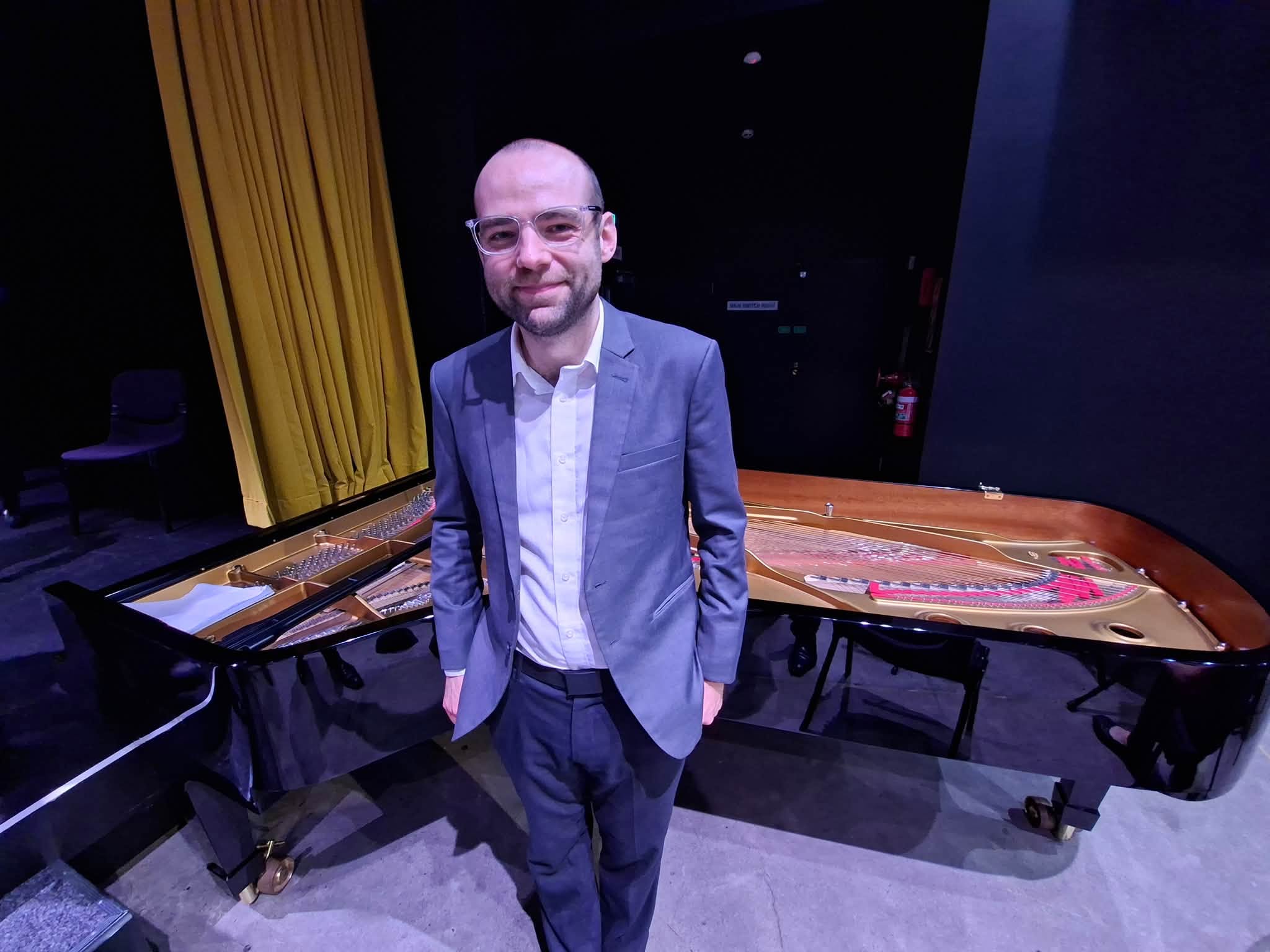
| | | | | | | | Beyond the clinic: Meet the rural doctor taking centre stage | | | | Above: Ben Brooking.
Image courtesy of New Zealand Doctor's Orchestra (NZDO) Facebook page. | |
For Dr Ben Booker, life on the West Coast brings together two very different pursuits: rural medicine and classical music. A rural medicine practitioner, Ben recently took centre stage as piano soloist with the New Zealand Doctors’ Orchestra, performing Beethoven’s Emperor Concerto.
We caught up with Ben to learn more about his journey in medicine and music, how he balances the two, and what he enjoys about living and working on the West Coast.
Can you tell us a little about your role in rural medicine and the work you do on the West Coast? I've been lucky enough to work on the Coast for the last year and a half now as a rural generalist, working between the medical ward, emergency department, general practice, and the unit in Westport. It's a truly varied and stimulating job where no two days are the same. There's a great team of colleagues, and patients are as tough as old boots. How did you first get into classical piano, and what has music meant to you throughout your life? I had always been interested in music as a kid, but took proper lessons since I was six. Music has been a great way of refining a skill set, cultivating creativity, and being able to communicate with people and audiences in a way that verbal communication can only approximate. What does it take to balance your clinical work with the time and practice required to perform at this level? Just like anything, music in my life has seasons: there are months where I scarcely touch the piano, followed by months where all of my free time is devoted to it. Medicine, particularly in training, is not very friendly to creative pursuits, which require a lot of empty time just to ponder about life and meaning. But happily this year, I have finished my exams and I'm starting to reclaim a bit of empty time to devote to music and creativity again. Has your experience in medicine influenced how you approach music, or vice versa? There are certainly many links between the two below the surface. Both are about helping people to live fulfilling, meaningful lives as one speck in the intricate web of humanity. Music and medicine are fundamentally about communication and truth, but viewed through opposite ends of a telescope. The search for medical truth is around a demonstrable, evidence-based truth, whereas music finds fulfilment in the broader, more remote truths of beauty and meaning. Both rely heavily on things that are not said as an important part of communication: if we took everything our patients said literally, we would probably not get too far, but to be able to pick up on inflections and subtleties is an important aspect of long-term medicine, just as it is part of music. Music has also been great training to cope with pressure, change plans at the drop of a hat, and working in teams of people with diverse opinions. But alas, it has not brought joy when being forced to listen to the playlists of surgeons in theatre. What would you say to other rural health professionals who have interests they'd like to make more time for outside of work? The three pieces of advice I would give are: number one, find a crowd. Creativity flourishes when it is provoked, challenged, and enlightened by a collision of ideas. While it's fun to make things by oneself, the challenge in rural is to find people that can explore and challenge things to create growth. Secondly, to have an end goal. While I'm not a goal-orientated person by any stretch, having some deadlines assists in committing to a particular level of achievement, whether it's a small concert for a friend or writing a poem for a competition deadline. It's been said that the secret to achievement is having two things: a plan and not quite enough time. The third thing is definitely the hardest, which is to build non-work time into one's life. Most people who go into rural health have a vocational approach to their work, which I definitely advocate for, but sometimes we need reminders to step back off the conveyor belt and remind ourselves what it is that we try to make people healthy for. It's hard to inhabit a creative, collaborative state when we are overrun putting out fires, but sometimes in a break from work, we realise that's what we've been doing for ages without even knowing it. What do you enjoy about living and working on the West Coast? Often I feel like living on the West Coast is a glimpse into what New Zealand would be like before mass human settlement. The land is wild and dense with flora, hiding incredible hidden walks, wildlife, and an air of rugged mystery. The work here has been a great gift, with the ability to work across many different areas alongside other health professionals working at the top of their game. Finally, corny though it sounds, West Coasters are such a great population to have as patients - I feel privileged to walk their journeys alongside them and be taught by them. | |
Ben’s story is a reminder that rural health professionals bring a wide range of talents, interests and experiences to their communities. While the demands of rural medicine can be significant, making space for the things we enjoy outside work can be an important part of a fulfilling life. For Ben, that means finding harmony between caring for West Coast communities and pursuing his passion for music. | | | | Rural Surgical Outreach Clinics | | New Zealand studyS. Cowan, K. Hill, and J.-L. Rahiri, “ Combatting Postcode Lottery: A Qualitative Exploration of Staff Perspectives on Rural Surgical Outreach Clinics in Hawke's Bay, Aotearoa New Zealand,” ANZ Journal of Surgery (2026): 1–9
"Anyone working in rural health will recognise the issues described in this paper. When specialist services come to rural communities, patients save time, money, and stress, and care becomes more accessible. However, the study also shows how fragile some of these solutions can be."
ABSTRACT BackgroundRural communities in Aotearoa New Zealand experience inequitable access to surgical care. Rural surgical outreach clinics aim to reduce geographic and financial barriers by delivering specialist care closer to patients. Healthcare professionals' perspectives on the functioning, value and sustainability of these services remain underexplored.
MethodsA qualitative descriptive study was conducted using semi-structured interviews with nine staff members (consultant surgeons, nurses, junior doctors and administrative staff) purposively sampled from general surgical outreach clinics in Waipukurau and Wairoa, Hawke's Bay, Aotearoa New Zealand. Interviews were audio-recorded, transcribed verbatim and analysed using inductive thematic analysis.
ResultsFive interconnected themes were identified: (1) bringing care to the people—outreach as equity in action; (2) reducing the hidden costs of care; (3) relationships, cultural safety and trust; (4) staff as agents of change and rural outreach champions; and (5) the fragility and sustainability of outreach services. Participants perceived outreach clinics as improving access to specialist care, reducing the practical and financial burden of travel for patients, strengthening relationships with rural and Māori patients and enhancing team cohesion and professional fulfilment. However, outreach services were seen as vulnerable to resource constraints, centralised booking processes, reliance on committed individuals and policy pressures favouring centralisation.
ConclusionRural surgical outreach clinics form part of a rural and regional model of healthcare that mitigates barriers for patients and the wider health system. Sustaining and scaling these services will require deliberate institutional support and appropriate resourcing. | | | | | | Rural CME Webinar - Nov 9th 2026 730pm | |
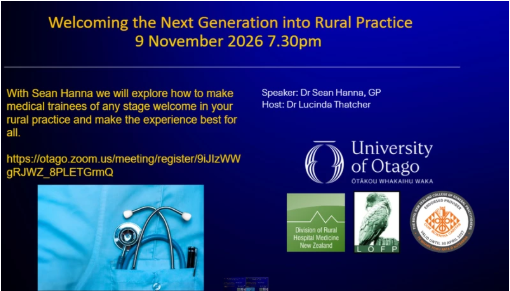
Welcoming the next generation into rural practice
Come along to discuss hosting medical trainees in your rural practice.
After a wee hiatus the rural CME webinar returns.
This session features Sean Hanna and Ralston D'Souza exploring what it means to have medical trainees in our practices and how to make the most of the experience for everyone involved. | | | | | | | | Postgraduate Programs in Women's Health for the attention of Doctors PGY1 and above, Nurses, Midwives and Physios | | | | | | | | | | | | | | Digital health in practice: making technology work for clinicians and patients Tuesday 17 November in Auckland | | | |
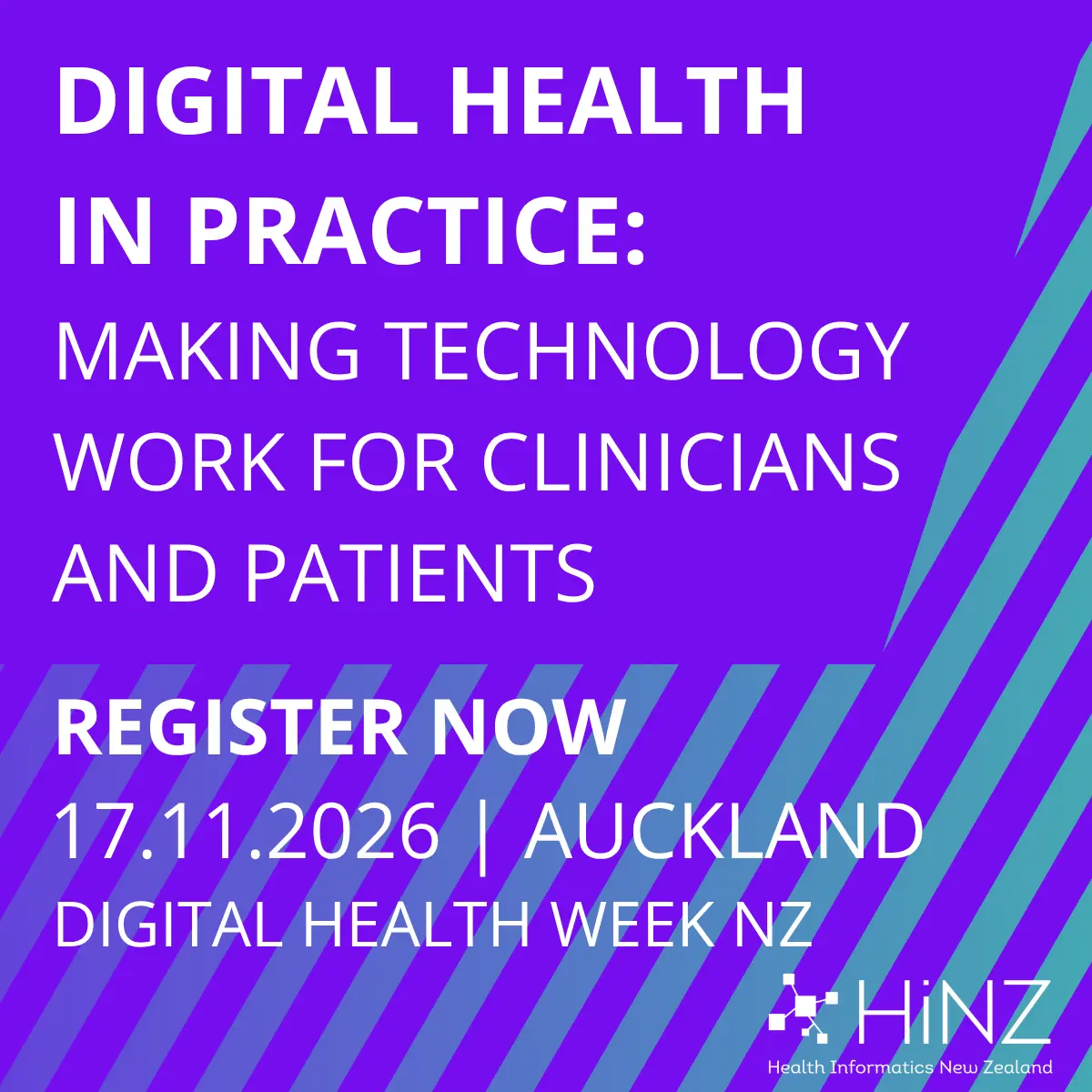
HiNZ have designed this practical, clinician-focused workshop around many of the challenges rural and primary care teams face every day – fragmented patient information, disconnected services, duplicated work, growing administrative demands and the pressure to deliver more care with limited resources.
There are several sessions particularly relevant to the issues your members face day-to-day: - Reducing duplication and administrative burden: Hear from Tāmaki Health's Chief Digital Officer and Chief Operating Officer about tackling inefficiencies in one of New Zealand's largest primary care organisations.
- Making technology work for patients: Explore how to design digital tools around real clinical and patient needs, including a hands-on session diagnosing and redesigning a broken patient experience.
- AI in everyday clinical practice: Learn from real implementations of AI scribes, explore how to evaluate clinical apps, and discuss patient safety, trust and the importance of protecting the clinician-patient relationship.
- Connected, coordinated care: Discover how better use of data, virtual health technologies and digital tools can improve patient experiences and support more joined-up care.
Workshop details Date: Tuesday 17 November 2026
Time: 8:50am – 4:50pm
Venue: Due Drop Events Centre, Manukau, Auckland
Workshop-only registration: $199 + GST for HiNZ members or $299 + GST for non-members. Attendees do not need to register for the wider Digital Health Week Conference to participate.
| | | | | | If you have feedback for us or want to reach out to us regarding something, feel free to contact us via the details provided below.
Write an email to communications@htrhn.org.nz to get connected with our team.
| | | | | | | | | | | | | | | | | |